Princely House of Kiev, Tchernigov and Karatchev (Ukraine/Belarus/Russia)
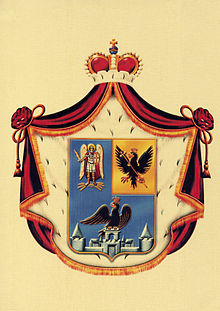
PRINCELY HOUSE OF KIEV, TCHERNIGOV AND KARATCHEV
HISTORICAL, GENEALOGICAL AND LEGAL REPERTORY
The Princely House of Kiev, Tchernigov and Karatchev is the direct descendant of Rurik the Great (862 d.c.) Grand Duke of Kiev (from which the Predicate of Kiev), from Saint Michael II, Grand Prince of Tchernigov (martyred by the Tartars in 1246 and later canonized) from which the Predicate of Tchernigov and his son Grand Prince Mstislav of Karatchev, author of Karatchevsky Princes (from which the Predicate of Karatchev).
The detailed analysis of the family trees of the Princely House highlights the linearity of direct descent from the original Rurikid lineage, whose Fons Honorum has remained unchallenged and unchanged over the centuries.
The history of the Principality of Tchernigov belongs to the most honourable tradition of Ukraine and culminated in 1246 with the figure of the Grand Prince Michael II of Tchernigov, who died fighting against the Tartars and was canonized by the Orthodox Church for refusing to submit to the Tartars.
The chronicles of the time report of the heroic Prince St. Michael II of Tchernigov, in the presence of his cousin Alexander Nievsky, Author of the Imperial House of Russia, resisted with all his forces to honor the Tartar Khan and his idols.
Against this brave refusal, the Great Prince Michael was stabbed to death by the Khan’s soldiers.
The death of the Grand Prince Michael led to the collapse of the Tchernigov Principality, so that his four children, regrouped to resist the Tartars in four sub-principalities, militarily organized, of which that one of Mstislav, Prince of Karatchev, survived the invasion and succeeded to seal a lasting peace with the Khan.
Since Sovereignty is a prerogative never subjected to a third power, having the Grand Prince Michael II Tchernigov (ancestor of the actual Grand Prince Michel of Kiev) rather die on the field than to submit to the Mongol invaders, this has avoided the debellatio of the House of the Princes of Kiev, the Tchernigov and Karatchev, allowing it to maintain in perpetuity the sovereign prerogatives of Ius Honorum, Ius Maiestatis, and the International Subjectivity of its Head of Name and Arms, in accordance with customary International Law.
The House of Princes of Kiev, Tchernigov and Karatchev,is therefore the rightful Claimer to the Throne of Ukraine (publicly stated through the edition of the valuable book in Polish “Monarchies Swiata” (in English: “World Monarchy”) by Tadeusz Pasierbinski, ISKRY editions Warsaw, 2002 by entering the Grand Prince of Kiev in synoptic table next to the greatest exponents of the current monarchies Rulers (like the Queen of England and the King of Spain)
The Rank of Grand Prince (pronounced in Ukrainian Veliky Kniaz) differs from that of Prince of merit or younger heir of a sovereign family and represents a degree of unfailing sovereignty comparable to that of a King. In fact, in the Ukrainian Orthodox tradition the figure of the King Catholic is replaced by the Veliky Kniaz, which is always sovereign in all juridical effects.
The Princely House of Kiev, Tchenigov Karatchev is quoted on the most outstanding historiographical Ukrainian, Russian and Polish Repertoires, which ensure the legal capacity of its Fons Honorum
In particular, in Europe, the House enjoys the Juridical Assessment of no. 825 of September 23, 2012 with European Decree which ensures that the Grand Prince of Kiev, the Tchernigov and Karatchev, is the Head of Name and Arms of the House of the Sovereign Princes of Kiev, Tchernigov and Karatchev (Ukraine) and has legitimately inherited the status of Veliky Kniaz (in Ukrainian: Grand Prince) of Ukraine and of Royal Highness, the legal prerogatives of the Ius Honorum and Ius Maiestatis, as well as the status of Subject of International law.
From this it follows that whoever is worthy, can receive the Grace or Justice Warrants with which the Princely House of Kiev, Tchernigov and Karatchev grants or renews Noble Titles which are are fully legal and effective.
The House of Kiev, Tchenigov Karatchev and is quoted on the most outstanding historiographical Ukrainian, Russian and Polish Repertoires, which ensure the legal capacity of its Fons Honorum
To help support its most benevolent humanitarian endeavours, it has been established, on June 18, 2009, the “Most Serene Noble Corporation of the Counts and of the Barons of Tchernigov”, with Apostille according to the Den Haag Convention of 5 October 1961, to raise awareness and to mobilize substantial resources for its active engament in many humanitarian activities, as to support disadvantaged childhood in the country and in favour of the Ukrainian Orthodox Church.
Bibliographic Citations:
Tadeusz Pasterbinsky, Monarchia Swiata, Ed. ISKRY, 2002
Komaroff-Kourloff, N., Union of Russian Nobility, preface of Prince Serge Obolensky, Titres Nobiliaires, Paris, 1985
Roman-Ivanovitch Ermerin, Princes of the Empire, Imperial Library H. Schmitzdorff, Saint Petersburg,1889
Bagalei, D. Istoriia Severskoi zemli do poloviny XIV st. (Kyiv 1882)
Encyclopedia of Ukraine, vol. 1
Hrushevs’kyi, M. Istoriia Ukraïny-Rusy, 8 vols (Lviv 1898–1918)
Andriiashev, O. ‘Narys istoriï kolonizatsiï Sivers’koï Zemli do pochatku XVI v.,’ ZIFV, 20 (Kyiv 1928)
Kuczyński, S.M. Ziemie Czernihowsko-Siewierskie pod rządami Litwy (Warsaw 1936)
Mavrodin, V. Ocherki istorii Levoberezhnoi Ukrainy (Leningrad 1940)
Kuczyński, S.M. Studia z dziejów Europy Wschodniej X–XVII w. (Warsaw 1965)
Zaitsev, A. ‘Chernigovskoe Kniazhestvo,’ in Drevnerusskie kniazhestva X–XIII vv. (Moscow 1975)
Dimnik, M. Mikhail, Prince of Chernigov and Grand Prince of Kiev, 1224–1246 (Toronto 1981)

 Institut Héraldique International - International Heraldry Institute - Institut Héraldique International