Grand Ducal House of Volhynia, Galicia and Lodomeria (Poland/Ukraine)
Grand Ducal House of Volhynia, Galicia and Lodomeria
Grand Duchy of Volhynia and Grand Duchy of Galicia and Lodomeria
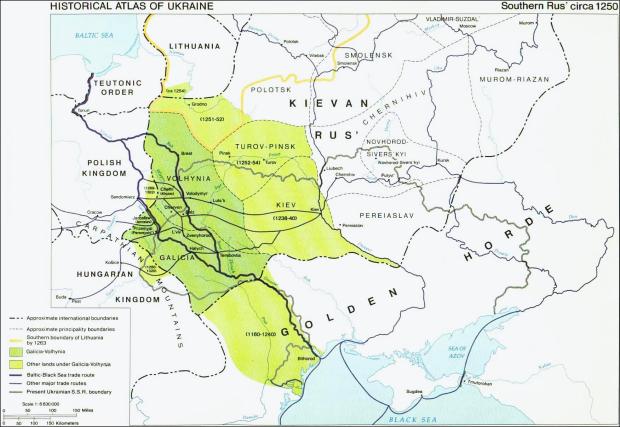
This region was first mentioned in the medieval chronicle Povist’ vremennykh lit (Tale of Bygone Years), which described Grand Prince Volodymyr the Great ‘s war with the Poles in 981 and his annexation of Peremyshl and the Cherven towns to Kyivan Rus . In 992, Volodymyr marched on the White Croatians and annexed Subcarpathia . Thus, by the end of the 10th century all of Galicia’s territory was part of Kyivan Rus’, so under the direct control and influence of the hegemonic Principality of Kiev/Tchernigov and must be, from that time, considered as a feudal entity, subject to the Principality of Kiev/Tchernigov, whose Grand Prince was endowed with the perpetual right to always dispose of the final decision power on this particular territory.
After the death of Grand Prince Yaroslav the Wise in 1054, Kyivan Rus’ began to fall apart into its component principalities. From 1084 Yaroslav ‘s great-grandsons, Riuryk Rostyslavych ,Volodar Rostyslavych , and Vasylko Rostyslavych, ruled the lands of Peremyshl, Zvenyhorod , and Terebovlia. Volodar’s son, Volodymyrko Volodarovych, inherited the Zvenyhorod principality in 1124, the Peremyshl principality in 1129, and Terebovlia principality and Halych land in 1141; he made princely Halych his capital. Volodymyrko’s son, Yaroslav Osmomysl , the pre-eminent prince of the Rostyslavych dynasty, enlarged Halych principality during his reign (1153–87) to encompass all the lands between the Carpathian Mountains and the Dnister River as far south as the lower Danube River. Trade and salt mining stimulated the rise of a powerful boyar estate in Galicia. The boyars often opposed the policies and plans of the Galician princes and undermined their rule by provoking internal strife and supporting foreign intervention. When Volodymyr Yaroslavych, the last prince of the Rostyslavych dynasty, died in 1199, the boyars invited Prince Roman Mstyslavych of Volhynia to take the throne.
Roman Mstyslavych united Galicia with Volhynia and thus created the Principality of Galicia-Volhynia. It was ruled by the Rus’ dynasty until 1340. The period from 1205 to 1238 in the Galician-Volhynian state was one of further intervention by Hungary and Poland, of internal strife among the appanage princes and the boyars, and hence of economic decline. During the reign of Danylo Romanovych (1238–64), however, Galicia-Volhynia flourished, despite the Mongol invasion of 1240–1. Danylo Romanovych promoted the development of existing towns and built new ones (Lviv, Kholm , and others), furthered the status of his allies (the burghers ), and subdued the rebellious boyars. Using diplomacy and dynastic ties with Europe’s rulers, he strove to stem the Mongol expansion. The Galicia-Volhynian state flourished under Danylo Romanovych’s successors. In 1272 Lviv became the capital, and in 1303 Halych metropoly was founded. But resurgent boyar defiance, the Mongol presence, and the territorial ambitions of Poland and Hungary took their toll. The Romanovych dynasty came to an end in 1340 when boyars poisonedPrince Yurii II Boleslav , and rivalry among the rulers of Poland, Hungary, Lithuania , and the Mongols for possession of Galicia and Volhynia ensued.
The Polish era. The struggle lasted until 1387. In 1340 King Casimir III the Great of Poland attacked Lviv and departed with the Galician-Volhynian regalia. A boyar oligarchy ruled Galicia under the leadership of Dmytro Dedko until 1349, when Casimir again invaded and progressively occupied it. In 1370 Casimir’s nephew, Louis I the Great of Hungary, also became the king of Poland; he appointed Prince Władysław Opolczyk in 1372 and Hungarian vicegerents from 1378 to govern Galicia. After the marriage of Grand Duke Jagiełło of Lithuania and Louis’s daughter, Queen Jadwiga of Poland, and the resulting dynastic union in 1386, an agreement was reached whereby Galicia and the Kholm region were acquired from Hungary by Poland, and Volhynia became part of the Grand Duchy of Lithuania .
Under Polish rule, Galicia was known at first as the ‘Rus’ land’ or Red Rus’ and was administered by a starosta , or vicegerent, appointed by the king. Roman Catholic dioceses were established in Peremyshl , Halych , and Kholm and were granted large estates and government subsidies. In 1365 a Catholic archdiocese was founded in Halych; it was transferred to Lviv in 1414. In the early 15th century, the region was renamed Rus’ voivodeship . Its capital became Lviv, and it was divided into four lands: Lviv, Halych, Peremyshl, and Sianik ; in the 16th century, the Kholm region was also incorporated. In 1434, Rus’ law , based on Ruskaia Pravda , was abolished in Galicia and replaced by Polish law and the Polish administrative system. Land was distributed among the nobility , who proceeded to build up latifundia and to subject and exploit the peasants .
From 1452 to 1569 Volhynia was a province of the Grand Duchy of Lithuania consisting of Volodymyr-Volynskyi, Lutsk, and Kremianets starostv. It came under increasing Polish administrative and economic influence, but maintained the church traditions, customs, and way of life of the Princely era. In the 15th and 16th centuries the princely and noble families led a continuing struggle against the Tartars, consolidated their privileged positions in society. As the Turks and Tartars blocked access to the Mediterranean markets, Volhynia strengthened its trade with the Baltic ports. In the 16th century the flow of Polish nobles and tradesmen into Volhynia, which was one of the most densely populated Ukrainian regions, increased. As Polish influence grew, the condition of the Volhynian peasantry became more difficult.
After the Union of Lublin (1569) Volhynia became a Polish crown voivodeship without losing its internal autonomy and Ukrainian character. The union, however, accelerated the Polonization of the administration and the upper estates of Volhynia. The struggle against Roman Catholicism and the Ukrainian national-cultural movement at the beginning of the 17th century was expressed in the writings of the opponents and the supporters of the Church Union of Berestia (1596) (see Polemical literature ), the Orthodox opposition to the Reformation in Hoshcha , Lutsk, and elsewhere, the activities of the Orthodox brotherhoods in Ostrih , Volodymyr-Volynskyi , and Lutsk (see Lutsk Brotherhood of the Elevation of the Cross ), and the founding of the Ostrih Academy , schools in Volodymyr-Volynskyi, Lutsk, Dubno , and elsewhere, and printing presses in Ostrih, Pochaiv , Derman, Kremianets , Kostiantyniv, and Chetvertnia.
The insurrections of Kryshtof Kosynsky (1591–3) and Severyn Nalyvaiko (1595) received wide support in Volhynia. During Bohdan Khmelnytsky ‘s uprising rebel groups led by MaksymKryvonis, I. Donets, and M. Tyt were active there. Some of the battles of the Cossack-Polish War of 1648–57 took place in Volhynia (Zbarazh , Vyshnevets, Brody , and, most notably, the Battle of Berestechko ). Nevertheless Volhynia never became part of the Hetman state but remained a province of Poland
Major social changes occurred in Volhynia and Galicia. Boyars who refused to convert to Catholicism forfeited their estates. Many resettled in the Lithuanian lands; those who did not became impoverished, déclassé petty gentry and, with time, commoners. Certain boyars received royal privileges; they gradually renounced their Orthodox faith and stopped speaking Ukrainian, and became instead Polonized Catholics. The tendency to assimilate permeated all of Galicia’s upper strata and was particularly prominent in the second half of the 16th century; by the end of the 17th century most of the Ukrainian nobility had become Polonized. At the same time Ukrainian merchants and artisans were deprived of their rights by the now favored Polish Catholic burghers who colonized the towns and received official positions and privileges granted solely to them by Magdeburg law. Polish government circles encouraged the inflow of Polish and foreign nobles and Catholicpeasants into Volhynia and Galicia. The number of Poles, Germans, Armenians, and (later) Jews increased in the towns, where they established separate communities. The government’s discrimination and limitations imposed by the guilds on the Ukrainian burghers provoked them to form brotherhoods to defend their rights towards the end of the 16th century.
In the 16th century corvée was introduced in the Polish Commonwealth. This excessive exploitation of peasant labor, which in many cases became actual slavery, led to peasant uprisings, among them the Mukha rebellion of 1490–2. Many peasants also escaped from the oppression to the steppe frontier of central Ukraine.
The Orthodox church, which had the support of the Ukrainian masses, had played an important role in Galicia. Yet the separate existence of Halych metropoly had been opposed from 1330 on by the metropolitans of Kyiv, who resided in Moscow. Halych metropoly therefore had no hierarch in the years 1355–70 and was abolished in 1401. Halych eparchy had no bishop from 1406 to 1539. At the end of the 16th century, in response to the Roman Catholic threat as well as the Reformation, a Ukrainian Orthodox religious and cultural revival began. The defense of Ukrainian interests was assumed by the aforementioned brotherhoods. One of the first was the Lviv Dormition Brotherhood , which existed as early as 1463, but whose earnest activity began in the 1580s, when it received Stauropegion status and founded a school (Lviv Dormition Brotherhood School ), printing press (Lviv Dormition Brotherhood Press ) and hospital. Brotherhoods were founded in many other towns in Galicia using the one in Lviv as the model. Because of the brotherhoods, Galicia became an important center of Ukrainian cultural and religious life. The Lviv brotherhood, for example, nurtured such major Ukrainian figures as Petro Konashevych-Sahaidachny , Yov Boretsky , Yelysei Pletenetsky , Zakhariia Kopystensky , and Petro Mohyla .
After the 1596 Church Union of Berestia established the Ruthenian Uniate church, a long period of bitter internal strife between the Ukrainian Orthodox opponents of the union and its Uniate supporters ensued. (See History of the Ukrainian church and Polemical literature .) The Orthodox church lost its official status, which was not restored by the Polish king until 1632, and Galicia’s role as the bastion of Ukrainian Orthodoxy was eclipsed. When the efforts of the leaders of the Hetman state to unite all the Ukrainian territories failed, the Orthodox hierarchs inGalicia and the Lviv Dormition Brotherhood accepted the church union, and in 1709 Uniate Catholicism became the only faith practiced by Galicia’s Ukrainians .
After the war there were other manifestations of support for pan-Ukrainian political unity by Galicia’s Ukrainians, but not on a mass scale. Galicia remained primarily a theater where the Cossack and Polish armies clashed; consequently, much of its population fled and settled in the Hetman state and Slobidska Ukraine .
In the Polish era, popular reaction to Polish rule and oppression in Galicia also took the form of social banditry. The brigands, called opryshoks, were particularly active in Subcarpathia andPokutia from the 16th to the 19th century; their most famous leader was Oleksa Dovbush . From the second half of the 17th century, Poland experienced a series of wars and political, social, andeconomic crises leading to a general weakening of the regime that its neighbors (Austria, Prussia, and Russia) exploited. In 1772 the first partition of Poland occurred and a part of Galicia was annexed by the Austrian Empire forming the so called Galicia-Lodomeria, an ephimere Kingdom, which was disssolved after the fall of the Austrian Empire, as a consequence of World War I and then World War II, when Volyinia, Galicia and Lodomeria fell under the influence of USSR.
From 1992 they belong to the Republic of Ukraine and nowadays they are ruled by the respective Grand Ducal House restored, as juridical and historical entity, by the House of the Princes of Kiev (nominal titulars of the original Regions of Volhynia, Galicia and Lodomeria, since 1054)
From: Encyclopedia of Ukraine, vol. 5 (1993).
-Antonovich, V. ‘Arkheologicheskaia karta Volynskoi gubernii,’ Trudy 11 arkheologicheskogo s”ezda (Moscow 1901)
-Trudy Obshchestva issledovatelei Volyni, 1–13 (Zhytomyr 1902–15)
-Rocznik Wołyński, 1–8 (Rivne 1930–9)
-Richyns’kyi, A. Staryi horod Volyn’ (1938)
-Levkovych, I. Narys istoriï Volyns’koï zemli (Winnipeg 1953)
-Litopys Volyni, 1–15 (New York–Winnipeg 1953–88)
-Baranovich, A. Magnatskoe khoziaistvo na iuge Volyni v XVIII v. (Moscow 1955)
-Starodavnie naselennia Prykarpattia i Volyni: Doba pervisnoobshchynnoho ladu (Kyiv 1974)
-Tsynkalovs’kyi, O. Stara Volyn’ i Volyns’ke Polissia, 2 vols (Winnipeg 1984, 1986)
-Iakovenko, N.; Kravchenko, V. (comps); Kotliar, M. et al (eds). Torhivlia na Ukraïni, XIV–seredyna XVII stolittia: Volyn’ in Naddnipriashchyna (Kyiv 1990)
-Boiko, M. Bibliohrafiia volynoznavstva v Pivnichnii Ameritsi, 1949-1993 (Bloomington, Indiana 1993)
-Iakovenko, N. Ukraïns’ka shliakhta z kintsia XIV do seredyny XVII st.: Volyn’ i Tsentral’na Ukraïna (Kyiv 1993)
-Petro Hrytsak, Volodymyr Kubijovyč , Yaroslav Pasternak, Ihor Stebelsky
-Zubritskii, D. Kritiko-istoricheskaia povest’ vremennykh let Chervonoi, ili Galitskoi Rusi (Moscow 1845)
-Sharanevych, Y. Ystoriia Halytsko-Volodymyrskoy Rusy ot naidavniishykh vremen do roku 1453 (Lviv 1863)
-Levytskyi, I. Halytsko-ruskaia bybliohrafiia XIX-ho stolitiia s uvzhliadneniiem ruskykh izdanii poiavyvshykhsia v Uhorshchyni i Bukovyni (1801–1886), 2 vols (Lviv 1888, 1895)
-Zanevych, I. [Terlets’kyi, O.]. Znesenie panshchyny v Halychyni: Prychynok do istoriï suspil’noho zhytia i suspil’nykh pohliadiv 1830–1848 rr. (Lviv 1895)
Die österreichisch-ungarische Monarchie in Wort und Bild, 12: Galizien (Vienna 1898)
-Franko, Ivan. (ed). Materiialy do kul’turnoï istoriï Halyts’koï Rusy XVIII i XIX viku (Lviv 1902)
-Mises, L. von. Die Entwicklung des gutsherrlich-bäuerlichen Verhältnisses in Galizien (1772–1848) (Vienna 1902)
-Bujak, F. Galicya, 2 vols (Lviv 1908–9)
-Krevets’kyi, I. ‘Halychyna v druhii polovyni XVIII v.’, ZNTSh, 91 (Lviv 1909)
Baran, S. Statystyka seredn’oho shkil’nytstva u Skhidnii Halychyni v rr. 1848–1898 (Lviv 1910)
-Franko, Ivan. Panshchyna i ïï skasuvannia v 1848 r. v Halychyni (Lviv 1913)
-Bujak, F. Rozwój gospodarczy Galicyi (1772–1914) (Lviv 1917)
-Doroshenko, D. ‘Rosiis’ka okupatsiia Halychyny 1914–1916 rr.’, Nashe mynule , 1 (Kyiv 1918)
-Doroshenko, V. ‘Zakhidn’o-ukraïns’ka Narodna Respublika’, LNV, 1919, nos 1–3
Studyns’kyi, K. (ed). ‘Materiialy dlia istoriï kul’turnoho zhyttia v Halychyni v 1795–1857 rr.’, URA, 13–14 (Lviv 1920)
-Lozyns’kyi, M. Halychyna v rr. 1918–1920 (Vienna 1922, New York 1970)
-Vozniak, M. Iak probudylosia ukraïns’ke narodnie zhyttia v Halychyni za Avstriï (Lviv 1924)
-Levyts’kyi, K. Istoriia politychnoï dumky halyts’kykh ukraïntsiv 1848–1914, 2 vols (Lviv 1926–7)
-Shymonovych, I. Halychyna: Ekonomichno-statystychna rozvidka (Kyiv 1928)
-Levyts’kyi, K. Istoriia vyzvol’nykh zmahan’ halyts’kykh ukraïntsiv z chasu svitovoï viiny, 3 vols (Lviv 1929–30)
-Kuz’ma, O. Lystopadovi dni 1918 r. (Lviv 1931, New York 1960)
-Pasternak, Iaroslav. Korotka arkheolohiia zakhidno-ukraïns’kykh zemel’ (Lviv 1932)
-Andrusiak, M. Geneza i kharakter halyts’koho rusofil’stva v XIX–XX st. (Prague 1941)
-Barvins’kyi, B. Korotka istoriia Halychyny (Lviv 1941)
-Baran, S. Zemel’ni spravy v Halychyni (Augsburg 1948)
Matsiak, V. Halyts’ko-Volyns’ka derzhava 1290–1340 rr. u novykh doslidakh (Augsburg 1948)
-Pashuto, V. Ocherki po istorii Galitsko-Volynskoi Rusi (Moscow 1950)
-Kieniewicz, S. (ed). Galicja w dobie autonomicznej (1850–1914): Wybór tekstów (Wrocław 1952)
-Babii, B. Vozz’iednannia Zakhidnoï Ukraïny z Ukraïns’koiu RSR (Kyiv 1954)
-Materialy i doslidzhennia z arkheolohiï Prykarpattia i Volyni, 1–5 (Kyiv 1954–64)
-Tyrowicz, M. (ed). Galicja od pierwszego rozbioru do wiosny ludów 1772–1849: -Wybór tekstów źródłowych (Cracow 1956)
-Z istoriï Zakhidnoukraïns’kykh zemel’, 1–8 (Kyiv 1957–63)
-Najdus, W. Szkice z historii Galicji, 2 vols (Warsaw 1958–60)
-Grzybowski, K. Galicja 1848–1914: Historia ustroju politycznego na tle historii ustroju Austrii (Cracow 1959)
-Herbil’s’kyi, H. Peredova suspil’na dumka v Halychyni (30-i–seredyna 40-ykh rokiv XIX stolittia) (Lviv 1959)
-Kravets’, M. Narysy robitnychoho rukhu v Zakhidnii Ukraïni v 1921–1939 rr. (Kyiv 1959)
-Kompaniiets’, I. Stanovyshche i borot’ba trudiashchykh mas Halychyny, -Bukovyny ta Zakarpattia na pochatku XX st. (1900–1919 roky) (Kyiv 1960)
-Sokhotskyi, I. (ed). Istorychni postati Halychyny XIX–XX st. (New York–Paris–-Sidney–Toronto 1961)
-Steblii, F. Borot’ba selian skhidnoï Halychyny proty feodal’noho hnitu v pershii polovyni XIX st. (Kyiv 1961)
-Rozdolski, R. Stosunki poddańcze w dawnej Galicji, 2 vols (Warsaw 1962)
Hornowa, E. Stosunki ekonomiczno-społeczne w miastach ziemi Halickiej w latach 1590–1648 (Opole 1963)
-Herbil’s’kyi, H. Rozvytok prohresyvnykh idei v Halychyni u pershii polovyni XIX st. (do 1848 r.) (Lviv 1964)
-Kravets’, M. Selianstvo Skhidnoï Halychyny i Pivnichnoï Bukovyny u druhii polovyni XIX st. (Lviv 1964)
-Kosachevskaia, E. Vostochnaia Galitsiia nakanune i v period revoliutsii 1848 g. (Lviv 1965)
-Sviezhyns’kyi, P. Ahrarni vidnosyny na Zakhidnii Ukraïni v kintsi XIX–na pochatku XX st. (Lviv 1966)
-Bohachevsky-Chomiak, Martha. The Spring of a Nation: The Ukrainians in Eastern Galicia in 1848 (Philadelphia 1967)
-Hornowa, E. Ukraiński obóz postępowy i jego współpraca z polską lewicą społeczną w Galicji 1876–1895 (Wrocław 1968)

 Institut Héraldique International - International Heraldry Institute - Institut Héraldique International