Grand Ducal House of Ruthenia (Ukraine/Slovakia)
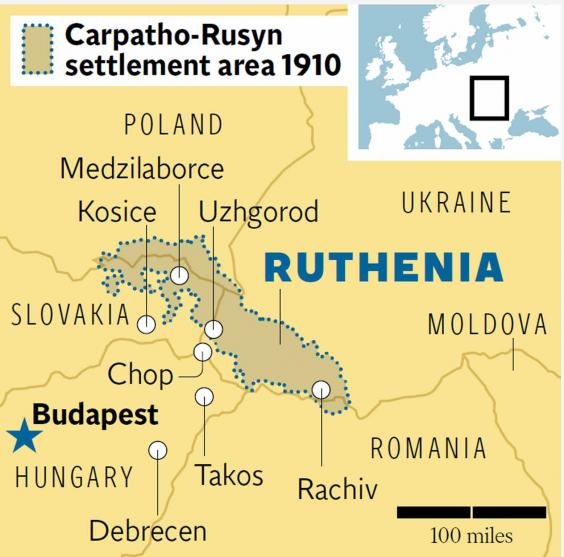
Ruthenia is a vaste territory comprised between Carpathian Mountains and the flat lands of Ukrainian Galicia (including the Region of Lviv), inhabited by a local population called “Ruthenians”
Following the incorporation of the Ruthenians by the Grand Prince of Kiev Vladimir into his realm, the name Rus’ or Ruthenia became usual in the region.
Since Ruthenia felt under the direct control and influence of the Principality of Kiev/Tchernigov it shared its political, social, economic, religious, and cultural development and therefore must be considered as a feudal entity accountable to the Grand Prince of Kiev/Tchernigov, who has always possessed the right to dispose of the final decision power on this territory. The Grand Duchy of Ruthenia was completely destroyed during the Tatar campaign against Hungary (1241), when the invaders made their way through the mountain passes. In the 13th and 14th centuries stone castles capable of withstanding a long siege were built in place of wooden stockades. Feudalism developed as well, and royal domains were transformed into gentry latifundia, which in part survived into the 20th century. Simultaneously thisregion was subdivided according to a new komitat , or territorial-administrative structure
In 1782, personal subjection of the peasants was abolished and serfdom was introduced, whereby the peasantry received certain personal and property rights; this, however, was not well enforced and often disputed by the Uniate church, officially renamed the Greek Catholic church ; despite it and its clergy were granted the same rights and privileges
The Greek Catholic Theological Seminary in Lviv was founded in 1783, and a special school, Studium Ruthenum (1787–1809), was established at Lviv University (founded in 1784) to train candidates for the priesthood who did not know Latin. These institutions prepared the future leaders of the Ukrainian cultural and national revival which occurred despite the fact that under the regime of State Chancellor K. von Metternich Austrian policy towards cultural and social emancipation in outlying provinces had changed for the worse. Under Leopold II, Ukrainian primary schools were abolished and Greek Catholic religion was very limited; and in 1812 compulsory education, introduced by Joseph II , was abolished. Lectures at Lviv University (which was closed from 1805 to 1817) were given in German and Latin, and Polish was the language of the primary schools. To counteract these developments, the church under Metropolitan Mykhailo Levytsky began founding Ukrainian-language parochial schools , which were approved by the emperor in 1818.
Under the impact of Romanticism and developments in Russian-ruled Ukraine and in other Slavic countries, a Ukrainian cultural and national renaissance began in 1820s. It was initiated by the seminary students Markiian Shashkevych , Yakiv Holovatsky , and Ivan Vahylevych , who were known as the Ruthenian Triad ; they published the first Ukrainianmiscellany , Rusalka Dnistrovaia (The Dnister Water Nymph), in 1837.
The main representative of this very particular Ukrainian territorialunit became the Supreme Ruthenian Council , which was founded in Lviv in May 1848. In its manifesto, the council proclaimed the unity of Ruthenians with the rest of the Ukrainian people and demanded the creation of a separate crown lands consisting of the Ukrainian parts of Galicia, Bukovyna , and Transcarpathia .
It published the first Ukrainian newspaper, Zoria halytska . Its representatives participated in the Slavic Congress in Prague, 1848 , where the Ukrainians were recognized as a separate people. The council also organized a national guard, the People’s Militia , and the Ruthenian Battalion of Mountain Riflemen. The existence of the council challenged the Polish claim that Ruthenia was part of Poland , and Polish leaders tried to undermine the council’s position by creating a pro-Polish body consisting of nobles and Polonophile intellectuals—the Ruthenian Congress , which published the newspaper Dnewnyk Ruskij . During the Revolution of 1848–9 the People’s Home in Lviv and the Halytsko-Ruska Matytsia society, were founded, and the Congress of Ruthenian Scholars was held.
The various political and cultural activities ended with the suppression of the revolution, aided by the intervention of the Russian army. The Supreme Ruthenian Council was forced to dissolve in 1851. The Polish leaders came to an agreement with the government whereby in exchange for their support they would have a free hand in administering the province. The actions of the Polish government disillusioned a section of the Ukrainian intelligentsia and contributed to the growth of the Russophiles who claimed an affinity between the language of Ruthenian Ukrainians and Russian. Their clerical-conservative leaders initially had a general, vague sympathy for tsarist Russia. These Old Ruthenians , as they called themselves, cultivated a macaronic, artificial idiom called yazychiie by its opponents and opposed the use of the Ukrainian vernacular, which was being promoted by their opponents, the Ukrainophile Populists . The Russophiles took control of the Halytsko-Ruska Matytsia society, the Stauropegion Institute , and the People’s Home in Lviv , and created the Kachkovsky Society in 1874. They also published the newspaper Slovo (Lviv), the popularjournal Nauka, the semimonthly Russkaia rada and Besieda, and other periodicals.
The Young Ruthenians —the young, secular intellectuals many of whom were teachers—organized the Populist movement in reaction to the cultural and political orientation of the Russophiles. They believed in the existence of a Ukrainian nation and considered themselves to be part of it, and they championed the use of the vernacular in schools and in literature . They maintained close ties with intellectuals in Russian-ruled Ukraine, including Panteleimon Kulish , Mykola Kostomarov , Oleksander Konysky, Mykhailo Drahomanov , Volodymyr Antonovych , and Mykhailo Hrushevsky . Inspired by the ideas expressed in the poetry of Taras Shevchenko , the ideology of the Cyril and Methodius Brotherhood , and the work of the Hromada of Kyiv , the Populists organized the Ruska Besida cultural society in 1861, the Prosvita educational society in 1868, and, with the co-operation and financial aid of Ukrainians under Russian rule, the Literary Shevchenko Society in Lviv (later the Shevchenko Scientific Society ) in 1873. They began publishing various periodicals, including the widely read Pravda (Lviv), Dilo , and Zoria (Lviv) . In the late 1870s a bitter struggle arose between the Russophile and Populist camps, in which the latter, supported by the students (among them Ivan Franko and Mykhailo Pavlyk ) and the majority of the Ukrainian intelligentsia, emerged victorious. Thereafter the Russophiles lost most of their popular support and became peripheral to cultural developments. The support given to the Populists by leaders from Russian-ruled Ukraine, especially Drahomanov, helped secure their victory. After 1992 its territory belongs to the Republic of Ukraine.
Nowadays it has been re-established as moral entity by the House of the Princes of Kiev (nominal titulars of the Grand Duchy, since 1340)
BIBLIOGRAPHY
Levyts’kyi, K. Istoriia politychnoï dumky halyts’kykh ukraïntsiv, 1848–1918, vol 1 (Lviv 1926)
Die österreichisch-ungarische Monarchie in Wort und Bild. (Vienna 1899)
Korduba, M. Iliustrovana istoriia (Chernivtsi 1901)
Nistor, I. Românii şi Rutenii în Bucowina (Bucharest 1915)
Korduba, M. ‘Perevorot na Bukovyni,’ LNV, 1923, nos 10-12
Piddubnyi, H. ïï mynule i suchasne (Kharkiv 1928)
Popovych, O. Vidrodzhennia (Lviv 1933)
Borot’ba trudiashchykh ’ne ta natsional’ne vyzvolennia i vozz’iednannia z Ukraïns’koiu RSR, 1917–1941: Dokumenty i materialy

 Institut Héraldique International - International Heraldry Institute - Institut Héraldique International